
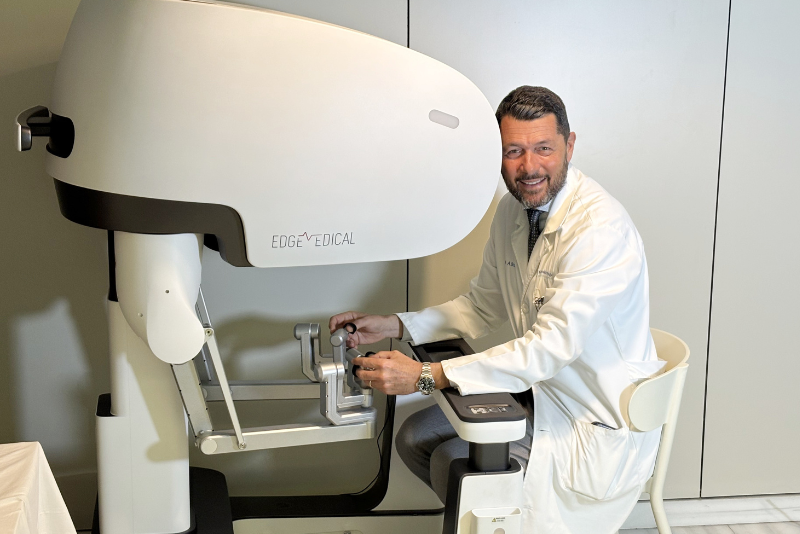
- The clinical, scientific, and educational model has been conceived and led by Dr. Alberto Breda, urological surgeon, president of the Robotic Surgery Section of the European Association of Urology (ERUS), and deputy director of the Urology Service at Fundació Puigvert in Barcelona, with operational and care implementation led by Dr. Pablo Juárez del Dago, robotic surgeon and director of GUA-UROINTEC in Las Palmas de Gran Canaria.
- Robotic tele-surgery has transitioned from a technological demonstration to a real clinical program after 18 months of work, consolidating a pioneering success case between Fundació Puigvert in Barcelona and the San Roque University Hospital in Las Palmas de Gran Canaria, separated by a distance of 3,000 km.
- This program constitutes the starting point for a broader deployment on a national and international scale and for the remote training of new generations of urological surgeons.
Barcelona / Las Palmas de Gran Canaria, February 2026
The first structured clinical program of robotic tele-surgery in Europe has been launched in Spain between Barcelona and the Canary Islands, a model conceived and clinically led by Dr. Alberto Breda, urological surgeon, president of the Robotic Surgery Section of the European Association of Urology (ERUS), deputy director of the Urology Service and head of the Oncological Urology Unit at Fundació Puigvert in Barcelona. The operational and care implementation of the program in the Canary Islands has been directed by Dr. Pablo Juárez del Dago, robotic surgeon and director of the GUA (Urology and Andrology Office) and UROINTEC, whose team has taken on the coordination of the surgical environment and the integration of the model into real hospital practice.
The program connects two hospitals separated by 3,000 km through a technological infrastructure developed by Edge Medical, consolidating a stable and reproducible surgical system in a care environment.
“It took us a year and a half to launch a clinical tele-surgery program in Spain, and this has been a challenge, but it is already a reality: we can connect two hospitals and perform remote tele-surgeries,” says Dr. Alberto Breda.
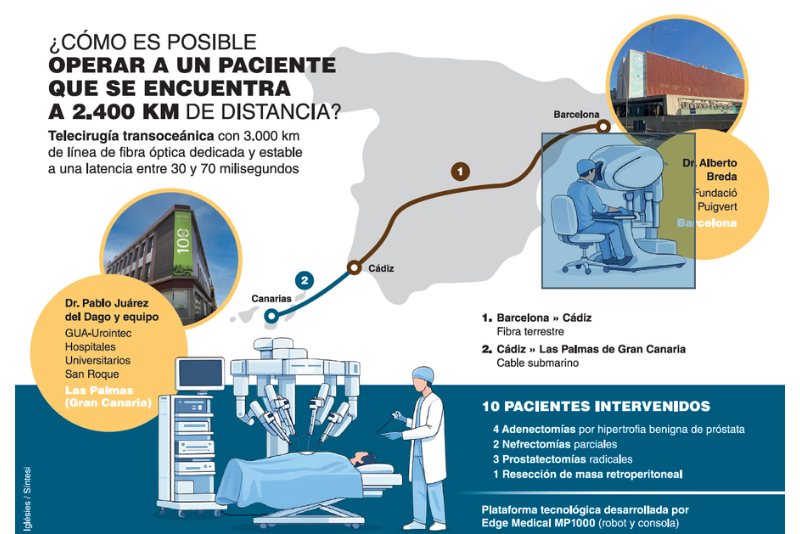
During the first three weeks of February, ten urological interventions of varying complexity have been carried out on patients from the Canary Islands —four adenomectomies for benign prostatic hyperplasia, two partial nephrectomies, three radical prostatectomies, and one resection of a retroperitoneal mass— executed in real-time from Barcelona by Dr. Alberto Breda, with the in-person assistance of Dr. Pablo Juárez del Dago and his team. Currently, all operated patients have been discharged and are recovering without complications.
In this regard, Dr. Breda points out:
“This program demonstrates that an expert surgeon can make their experience available to other patients with a local team that ensures maximum safety. That is why the model between Barcelona and the Canary Islands is working: there are great surgeons in both territories.”
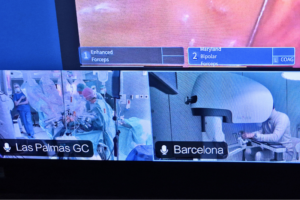
From the robotic console installed at Fundació Puigvert in Barcelona, the surgeon has directly operated on Canary Island patients in an operating room at the San Roque University Hospital in Las Palmas de Gran Canaria. According to Dr. Breda,
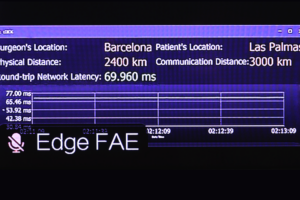
“the technical performance has been key: the average latency recorded ranged between 30 and 70 milliseconds, much lower than the 132 milliseconds recorded during the transcontinental partial nephrectomy I performed in 2024 between Bordeaux and Beijing,”
considered by the scientific community a global milestone in tele-surgery. This precedent established the foundations of the model that is now being implemented in a structured manner within the Spanish healthcare system, not as a technological demonstration, but as a clinical program within a real hospital environment.
“Tele-surgery is no longer an experimental technique, but a natural evolution of robotic surgery,” says the expert. “This program demonstrates that it is possible to articulate care networks between hospitals while maintaining the same standards of precision and safety as an in-person intervention. Moreover, it opens the door to reducing unnecessary travel and expanding access to complex procedures in expert hands, both nationally and internationally.”
From surgical strategy to care practice
The model developed by Dr. Alberto Breda integrates remote surgical leadership and clinical execution from Barcelona, while in the Canary Islands, the team of robotic surgeon Dr. Pablo Juárez del Dago ensures operational and care direction in the operating room, coordinating the surgical environment, patient preparation, and the integration of the model into regular hospital practice.
“Our challenge was not only to connect two operating rooms but to incorporate this model into the real care circuit with all clinical guarantees,” notes Dr. Juárez del Dago. “Tele-surgery only makes sense when it translates into a direct benefit for the patient and is seamlessly integrated into the work of the surgical team.” Likewise, “this type of technology and this way of working will enhance the surgical level and position the Canary Islands as a technological hub for robotic surgery, where it will be possible to operate and develop a training and mentoring program for new generations of urologists.”
Infrastructure and institutional collaboration
Fundació Puigvert acts as the scientific and training node of the program, home to the lead surgeon from where the surgical strategy is led and its experience is provided as an international reference center in urology and robotic surgery.
The San Roque University Hospital has been the care venue where the model has been clinically implemented, adapting the robotic operating room and coordinating the local medical and surgical team.
The technological infrastructure has allowed stable connection between both centers through an exclusive fiber optic network that links Barcelona and the Canary Islands over 3,000 kilometers apart, ensuring the necessary standards of stability and safety for advanced tele-surgery.
Connection between territories
Beyond the technological milestone, the program consolidates a vision of medicine based on cooperation between expert teams, knowledge transfer, and the reduction of territorial inequalities in access to high surgical specialization.
“The Canary Islands represent a strategic connection point between Europe, Africa, and America. Developing this program from there demonstrates that high specialization should not be concentrated exclusively in large healthcare capitals, but articulated in a network,” concludes Dr. Breda.
About Dr. Alberto Breda
Urologist, expert in oncological urology and kidney transplantation. Specialist surgeon in robotic surgery and pioneer in the clinical implementation of tele-surgery.
Clinical, scientific, and educational leader of the first clinical program of robotic urological tele-surgery implemented in Spain between Barcelona and the Canary Islands.
He is currently the deputy director of the Urology Service at Fundació Puigvert, a position he combines with the direction of the Oncological Urology Unit and the Kidney Transplant Surgical Team. President of the Robotic Surgery Section of the European Robotic Urology Section (ERUS) of the European Association of Urology (EAU 2022-2029). Deputy director of the Fundació Puigvert Chair of Urological Robotic Surgery-UAB, associate professor at UAB, and adjunct professor of Urology at Mount Sinai Hospital in New York (USA).
- In 2024, he performed the world’s first transcontinental partial nephrectomy, from Europe (France) to Asia (China) via tele-surgery.
• In 2022, he performed Europe’s first robotic partial nephrectomy with the HUGO™ robot.
• In 2015, he was the first surgeon in Spain to perform a complete robotic kidney transplant from a living donor with the Da Vinci robot.
About Dr. Pablo Juárez del Dago
Urologist expert in robotic surgery of the prostate, kidney, and bladder, as well as in laser surgery for the treatment of benign prostatic hyperplasia.
Clinical and operational deputy director of the first clinical program of robotic urological tele-surgery implemented in Spain between Barcelona and the Canary Islands.
Director of the urological group GUA-UROINTEC, he is the director of the Robotic Surgery Unit of GUA (Urology and Andrology Office) and the Urology Service of the San Roque University Hospitals in the Canary Islands. He leads the Technology Working Group of the Robotic Surgery Section of the European Robotic Urology Section (ERUS) of the European Association of Urology (EAU), focused on promoting innovation, training, and the democratization of robotic surgery in Europe. He collaborates with international leaders such as Dr. Richard Gaston and Dr. Alberto Breda on research projects.
About GUA-UROINTEC
GUA (Urology and Andrology Office) is the reference care clinic in urology and andrology in the Canary Islands, with over 35 years of experience.
UROINTEC is a Spanish company founded in 2018 by Dr. Pablo Juárez del Dago, based in Las Palmas de Gran Canaria, specializing in advanced urology services, innovation, and technology applied to health.
Together, GUA–UROINTEC promotes initiatives that integrate clinical practice, robotics, surgical connectivity, and advanced education, contributing to the technological transformation of the healthcare sector. In addition to its care activity, UROINTEC provides urology services to medical centers, clinics, and hospitals, and has strengthened its international projection through agreements with leading technological and medical companies in markets such as the United States and China.
About Fundació Puigvert
Fundació Puigvert is a monographic health institution in Urology, Nephrology, Andrology, and Reproductive Medicine, established in 1961 by Professor Antoni Puigvert Gorro with the aim of becoming a reference of excellence in these specialties.
Currently, as a university hospital center, privately managed and non-profit, it is dedicated to the study and medical and surgical treatment of pathologies and dysfunctions of the urinary system and the genital apparatus, particularly standing out for its high level of experience in the implementation of robotic surgery applied to urology and kidney transplants since, in 2005, it became the first hospital in Spain to perform a surgical intervention with a robotic system.
After more than 20 years leading this field, Fundació Puigvert takes a new step forward with the implementation of robotic tele-surgery, following an innovative evolution that reaffirms it as an institution that not only adopts technology but anticipates and develops the surgical models of the future.
Thanks to its long trajectory and the value of a highly specialized medical team with extensive medical, surgical, educational, and scientific experience, Fundació Puigvert is one of the healthcare centers in Europe with the highest volume of specialized care activity and high clinical excellence in Urology, Nephrology, Andrology, and Reproductive Medicine.
About San Roque University Hospitals
San Roque University Hospitals, with over a hundred years of experience as a reference in private healthcare in the Canary Islands, became in 2019 the first private hospital in the archipelago to obtain University qualification, a key milestone for research, development, and medical innovation.
The constant commitment to cutting-edge technology and high-complexity medicine places the group among the 50 best private hospitals in Spain, according to the 2024 Health Reputation Monitor. This positioning is reinforced by its presence in prestigious international rankings, such as World’s Best Hospitals 2024 – Spain (Newsweek), and by recognitions such as the New Medical Economics 2024 Award for the best-managed private hospital, which consolidate its leadership in excellence healthcare.
Contact and press release (PDF)
Images:

 Català
 Español