
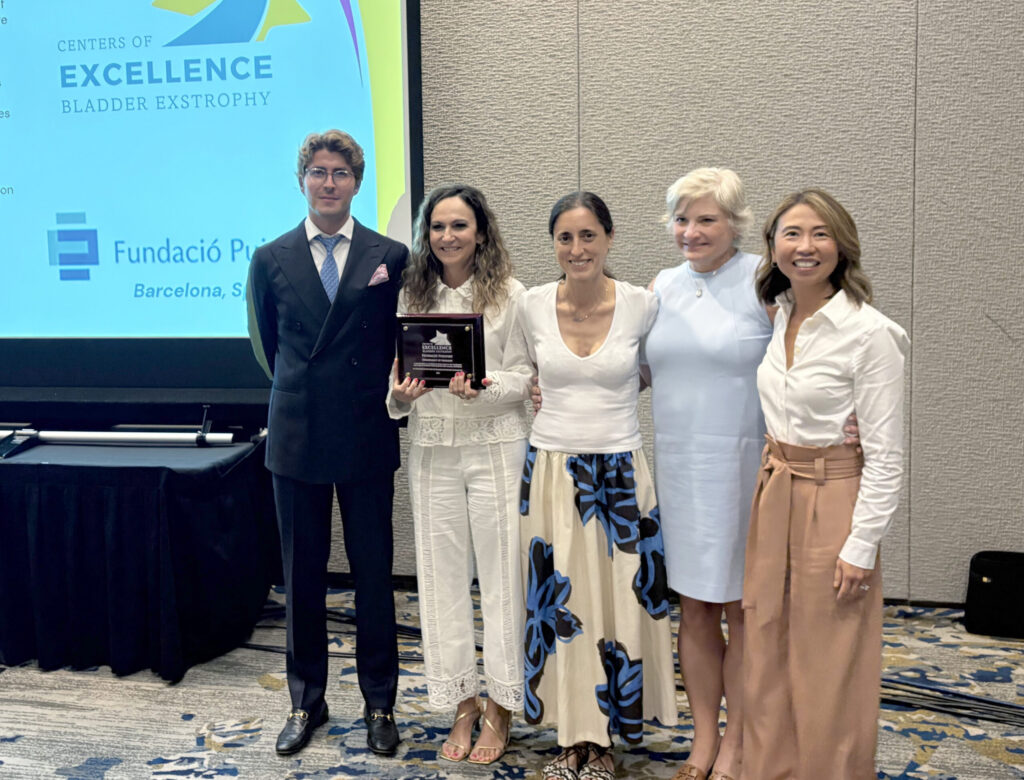
- Fundació Puigvert has been accompanying children and families living with this condition for nearly 50 years.
- The program, recognized by the Association for the Bladder Exstrophy Community, is led by Fundació Puigvert and is developed in collaboration with the Hospital de la Santa Creu i Sant Pau, with whom it shares healthcare activities.
Fundació Puigvert has been accredited as a new world Center of Excellence in bladder and cloacal exstrophy by the Association for the Bladder Exstrophy Community (A-BE-C), an international reference organization that promotes access to the highest quality medical care for children and adults with bladder and cloacal exstrophy. The accreditation was received by the head of the Pediatric Urology Unit of Fundació Puigvert, Dr. Anna Bujons, who is also the president of the Ibero-American Society of Pediatric Urology, during the annual A-BE-C conference held in Boston (USA). This recognition makes Fundació Puigvert the only Spanish and European center and one of thirteen centers in the world with this distinction.
Dr. Anna Bujons:
“This is a very significant milestone for our center and for the entire team. It represents years of rigorous work, commitment to quality care, and to the families living with such a complex malformation as bladder exstrophy.”
“This recognition reinforces our vocation for public service, proximity, and excellence. It is an encouragement to continue improving, sharing knowledge, and supporting families throughout the entire care process.”
What is bladder and cloacal exstrophy?
Bladder exstrophy is a severe and very rare congenital malformation, considered a rare disease, affecting approximately 1 in every 30,000 – 40,000 births. It occurs when the urinary bladder does not close properly during embryonic development, leaving it open to the outside, so that the baby is born with the bladder exposed outside the abdomen. This condition not only prevents urine storage but is also often associated with alterations in the structure of the genitals, impacting both appearance and long-term functionality.
In the most complex cases, it is referred to as cloacal exstrophy, an even more severe and rare malformation in which, in addition to the bladder, part of the intestines is also exposed to the outside. This exceptional and highly complex condition requires highly specialized medical and surgical care.
Children with exstrophy often undergo multiple interventions throughout childhood and adolescence with the aim of reconstructing the bladder and urethra, preserving kidney function, and improving urinary continence, among other goals. All of this is accompanied by thorough follow-up from a multidisciplinary team that cares not only for urinary and digestive functions but also for the emotional well-being and quality of life of patients and their families.
What is A-BE-C and why is this recognition so important?
A-BE-C is a non-profit international entity founded by patients, families, and healthcare professionals that provides support, information, and global connection for individuals affected by bladder and cloacal exstrophy. Its Centers of Excellence program recognizes those institutions that meet 10 rigorous criteria for quality care, such as specialized surgical experience, multidisciplinary approach, structured transition pathways, long-term follow-up, and direct involvement with families and patient associations.
Fundació Puigvert thus joins a prestigious international network that includes centers such as Boston Children’s Hospital, Children’s Hospital Los Angeles, Children’s Hospital of Philadelphia (CHOP), Johns Hopkins Children’s Center, and Seattle Children’s, among others. During the conference held in Boston, it was the executive director of A-BE-C, Pamela Artigas, who presented Dr. Bujons with the accreditation of Fundació Puigvert as a new member of this international network.
Pamela Artigas:
“Receiving a diagnosis of bladder exstrophy can be an overwhelming experience for families, especially since many general practitioners, gynecologists, and obstetricians may have limited familiarity with the condition.”
“The Center of Excellence program was established to ensure that patients and their families can quickly access expert, comprehensive, and the highest quality care.”
A consolidated and officially recognized trajectory, in collaboration with the Hospital de la Santa Creu i Sant Pau
Fundació Puigvert has a trajectory of nearly 50 years in specialized care for patients with bladder and cloacal exstrophy, since the creation of its Pediatric Urology Unit. The program recognized by A-BE-C as a Center of Excellence is led by Fundació Puigvert and is developed in collaboration with the Hospital de la Santa Creu i Sant Pau, with whom it shares healthcare activities within the framework of Sant Pau – Campus Salut Barcelona. This collaboration ensures an integrated care environment, with access to complementary high-complexity pediatric and adult services.
The Foundation is already accredited by various official and international institutions for its expertise in this pathology:
- It is part of the Clinical Expertise Units Network (XUEC) of the Catalan healthcare system.
- It is a CSUR center (State Reference Center, Service, and Unit), with the Hospital de Sant Pau, accredited by the Ministry of Health for the treatment of bladder and cloacal exstrophy.
- It is a member center of eUROGEN, the European reference network for rare and complex urogenital diseases, promoted by the European Union.
The Pediatric Urology Unit as the core of the care circuit
The Pediatric Urology Unit of Fundació Puigvert is the central point of the care circuit in addressing bladder and cloacal exstrophy. From this unit, an integrated and multidisciplinary model is coordinated that supports patients from prenatal diagnosis to adulthood. This approach involves the participation of professionals from gynecology, plastic and reconstructive surgery, general surgery, nephrology, andrology, traumatology, psychology, and advanced practice nursing, among others, who are incorporated according to the needs of each life stage.
The model is based on personalized and continuous care centered on the individual, taking into account both medical and surgical aspects as well as psychosocial factors to ensure the physical, emotional, and social well-being of the individuals cared for and their families. The status of a reference center allows it to care for patients from all over the territory, from other autonomous communities, and also from other countries.

 Català
 Español