
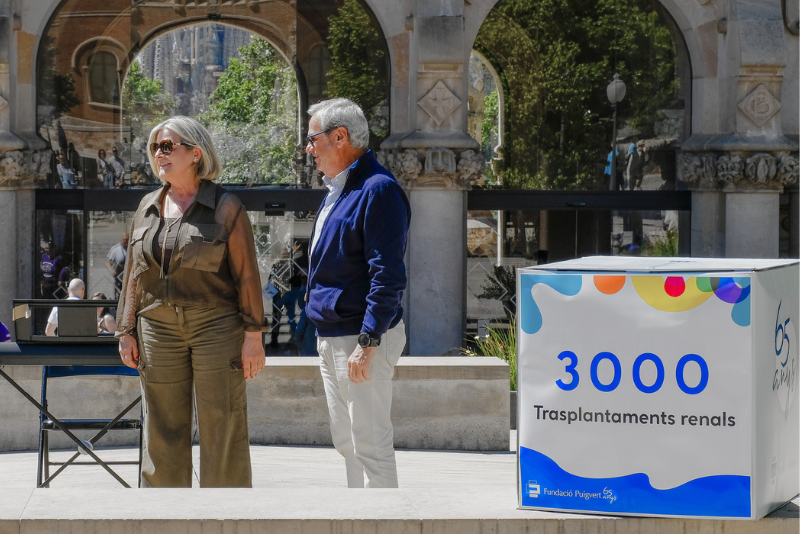
Coinciding with the week in which the National Organ and Tissue Donor Day and the World Transplant Patient Day are celebrated, Fundació Puigvert highlights the importance of donation and kidney transplantation after achieving, in 2026, the milestone of 3,000 kidney transplants. The institution celebrated this milestone last May at the Modernist Site of Sant Pau, as part of the Patient Festival and within the commemorative events of the 65th anniversary of Fundació Puigvert.
The event featured the participation of patients, professionals, and families, and gave special prominence to those who have experienced a kidney transplant. Among them was Àngel Ferreny, 66 years old and residing in Lleida, who is now part of the history of Fundació Puigvert as the 3,000th kidney transplant patient. After suffering from renal failure and facing the need to start hemodialysis or receive a transplant, last October he received a kidney from his wife, who gave him a new opportunity and, at the same time, became the institution’s 650th living donor.
Dr. Carme Facundo, nephrologist and head of the Kidney Transplant Unit at Fundació Puigvert, emphasizes that:
“Kidney transplantation is the most effective treatment for many patients with end-stage renal disease, as it offers greater survival and a better quality of life compared to dialysis.”
Thanks to the accumulated experience and the high levels of excellence achieved, the survival rate of kidney transplant recipients at Fundació Puigvert is 85% after 15 years post-transplant.
This year also marks a decade since the first complete kidney transplant with robotic surgery in Europe on a young 25-year-old patient, performed by Dr. Alberto Breda, head of the Kidney Transplant Surgical Team at Fundació Puigvert and one of the world’s leading experts in robotic kidney transplantation, along with the French Dr. Doumerc. For Breda:
“Robotic kidney transplantation is the modality that provides the most clinical advantages to the recipient, with a more than acceptable safety for the living donor.”
Currently, a significant portion of kidney transplants are performed using robotic surgery, a minimally invasive technique that reduces complications and postoperative pain, decreases hospital stay days, and promotes faster recovery, in addition to improving the aesthetic results of the intervention.
Kidney donation, in any of its modalities, is an act of altruism
Kidney transplantation is made possible by the altruistic donation of organs. Each donation can save or improve many lives, and the solidarity of donors and their families is essential to make this treatment possible.
The transplanted kidney can come from a deceased donor or a living donor. In both cases, the donation is a generous act that provides a therapeutic alternative to people with advanced or end-stage renal disease.
In the case of the living donor, the kidney can come from a family member, a friend, or a compatible volunteer. Usually, a person can live with one kidney without problems, as long as they have been thoroughly evaluated and meet the necessary medical, psychological, and legal criteria to ensure their safety.
In 2025, Fundació Puigvert performed a total of 113 kidney transplants, 25 of which were from living donors. This consolidates the institution’s trajectory as a reference center in kidney transplantation, accredited by the Organización Nacional de Trasplantes (ONT) and the Organització Catalana de Trasplantaments (OCATT). But, above all, it reaffirms its commitment to people: to patients who receive a new opportunity, to the families who accompany them, and to the donors who, with a generous gesture, make it possible to transform lives.


Stories that matter: transplantation in the first person
Behind every transplant is a story of life, overcoming, and trust. The experiences of those who have gone through this process help to better understand what it means to receive a new kidney, how life changes after the operation, and what impact it has on families and donors.
At Fundació Puigvert, patient testimonies are part of the commitment to a more humane and closer medicine. Sharing these stories is also a way to accompany other individuals and families who are starting this journey.
One of these stories is that of Katya and Nina, mother and daughter. Katya, a young Ukrainian resident in Spain, suffered from a severe kidney disease, and her mother, Nina, decided to become a living donor to offer her a new opportunity. Their experience is captured in the documentary “Story of a Transplant,” produced by Fundació Puigvert during the pandemic, which shows the value of living donation and the emotional, familial, and medical impact of this process.
Other real testimonies also show the diversity of situations that can lead to a living donor kidney transplant: donations among family members, incompatible couples finding an alternative, international donations, people avoiding starting dialysis, or patients regaining autonomy, studies, physical activity, and quality of life after the intervention.
Juan Acosta received a living donor kidney transplant after seven years on dialysis and after it was deemed that the risk of transplantation was too high at his previous center. It was his wife, Maria, who gave him a kidney.
“A transplant was not easy because there was a lot of calcification. If it weren’t for you, I would still be on dialysis,” he explains.
Soledad Valdillo received a second transplant from an incompatible living donor. In 2006, her mother gave her a kidney, and the second time it was her husband who donated one, despite having an incompatible blood type.
“In the second transplant, I didn’t even reach dialysis; they transplanted me beforehand. My husband lives a totally normal life. Nothing has changed,” she recalls.
There are also stories like that of Amparo Fontanet, who decided to donate a kidney to her daughter Inés when she, at 24 years old, had only one kidney functioning at 6%.
“I was 65 years old and had just retired, and I told my doctor that if my kidney wasn’t expired, we would go ahead,” she recounts.
Sara Nardelli received a kidney transplant thanks to an international donation from her aunt, who traveled from Argentina.
“My donor was my aunt; she came from Argentina, and everything was done in a few weeks,” she explains.
Altruistic donation is also part of these stories. Ramon Ferreny donated a kidney to a coworker who had different potential donors fail. After consulting with his family doctor, his wife, and his two daughters, he decided to go ahead.
“I didn’t care if they were family or not; it was a person who needed it, and I could do it. I wish I had two more kidneys to give,” he states.
Sonsoles received a kidney from an incompatible living donor after 14 months on dialysis, a process that initially seemed impossible due to blood type.
“They told me it was impossible due to blood type, and I was on dialysis… until they told us here that this had changed. I feel perfect, perfect. I am doing very well,” she explains.
And Juan, who donated a kidney to his brother when he needed a second transplant, sums up the life-changing impact of this gesture with one phrase:
“The second time was like seeing him be born again.”
These stories show that kidney transplantation is not just a highly complex medical procedure, but also a profoundly human experience. Each donation represents a new opportunity and highlights the importance of solidarity, professional support, and trust among patients, families, and care teams.

 Català
 Español