
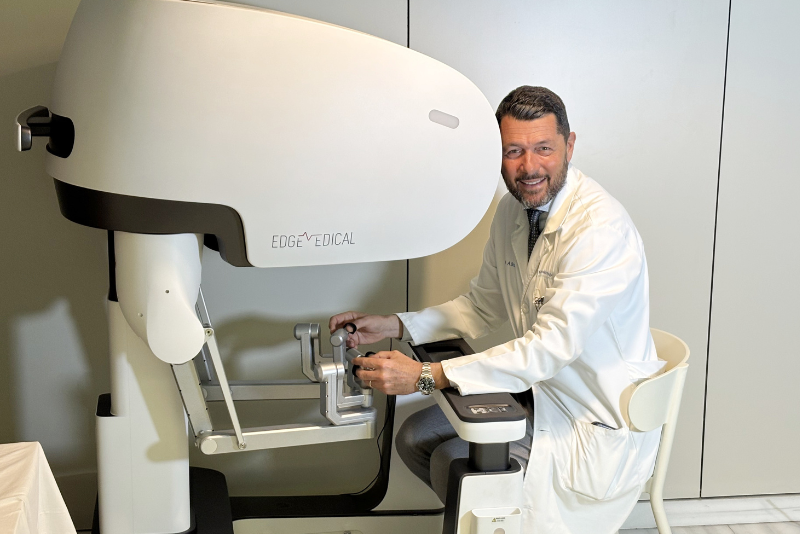
- It has taken two and a half years of work and a technology that, beyond the robotic platform, required connecting the Fundació Puigvert and the Hospital de San Roque via fiber optic cable, located 3,000 km apart.
- Dr. Breda already starred in September 2024 in the first transcontinental robotic tele-surgery between Europe and China, laying the foundations for a new surgical model that is now, with ten interventions, consolidating in the Spanish healthcare system as a real and structured clinical program.
Dr. Alberto Breda, president of the Robotic Surgery Section of the European Association of Urology (ERUS), deputy director of the Urology Service and head of the Oncological Urology Unit and the Renal Transplant Surgical Team of the Fundació Puigvert in Barcelona, has conceived, led, and clinically executed the first robotic tele-surgery program in Europe implemented between two Spanish hospitals. To carry it out, he has relied on Dr. Pablo Juárez del Dago, leading the GUA-UROINTEC team, which has made the application of the model in a real clinical environment possible, coordinating surgical and care activities at Hospital Universitario San Roque de Canarias.
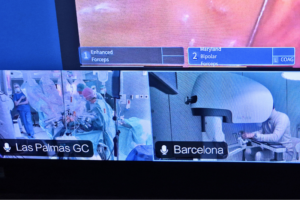
The implementation of this first clinical robotic tele-surgery program has connected the aforementioned hospital centers on the peninsula and the Canary Islands, separated by 3,000 km, through a fiber optic connection (600 km via submarine) that has linked the facilities of both centers.

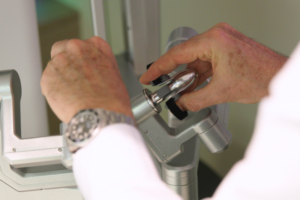
During the first three weeks of February, ten urological interventions have been carried out in a real care environment and with all clinical safety guarantees. Thus, Dr. Alberto Breda, from Barcelona, performed the surgeries of patients at the Hospital San Roque de Las Palmas de Gran Canaria manipulating the console of the MP 1000 robotic platform from Edge Medical, with the support of the GUA-UROINTEC team led by Dr. Pablo Juárez del Dago in the operating room of the island center.
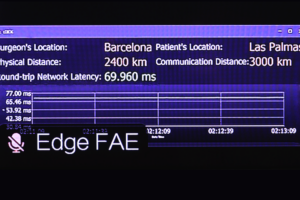
The interventions have recorded a latency of between 30 and 70 milliseconds, practically imperceptible to the surgeon and significantly lower than the 132 milliseconds recorded in the transcontinental intervention carried out between Bordeaux and Beijing in September 2024. This technical performance has been key to ensuring a smooth surgical experience and developing the program with the same standards of precision, control, and safety as an in-person robotic surgery.
The eleven interventions performed have included four adenomectomies for benign prostatic hyperplasia, two partial nephrectomies, three radical prostatectomies, and one resection of a retroperitoneal mass, covering both benign and oncological pathology, and procedures of varying surgical complexity.

The state-of-the-art technological equipment used in these interventions and the high specialization of the professionals have allowed the establishment of protocols specifically designed to ensure safety, continuity of care, and clinical quality at all times.
A real care model, not a technological demonstration
This program represents a fully operational care model, and not a one-off technological demonstration. Its clinical and organizational design has allowed validating robotic tele-surgery as an effective tool to improve access to high surgical specialization, especially in territories separated by the sea.
 Dr. Alberto Breda is convinced that “tele-surgery is not a test or an experiment, but a natural evolution of robotic surgery. This first program implemented in Spain confirms that it is a scalable project both nationally and internationally. In our country, it can promote the construction of a care network between hospitals that avoids patient transfers, thus helping to reduce healthcare costs; while, on a global scale, it will help people who do not have access to surgeries of this complexity in their home countries.”
From conceptual design to clinical practice
The program began with an initial phase of clinical and technological piloting, focused on the first two interventions, aimed at validating the architecture of the model, coordination between teams, and the stability of communications. Once this phase was overcome, the program gradually developed until completing eleven interventions under real clinical practice conditions.
 This experience is supported by more than two decades of leadership by Dr. Breda and the Fundació Puigvert in robotic surgery, as well as a consolidated trajectory of surgical innovation applied to urology.
In September 2024, Dr. Breda performed the world’s first transcontinental robotic partial nephrectomy, operating on a patient in Beijing from Bordeaux, over 8,000 kilometers away. That intervention was carried out with a latency higher than that recorded in the Barcelona–Canaries program and marked a turning point in demonstrating the viability of long-distance robotic surgery.
Institutions and technology at the service of the model
The GUA-UROINTEC team plays a key role in the operational and care implementation of the model, ensuring its viability in a real clinical environment and the correct integration of the program into routine surgical practice.
 The Fundació Puigvert acts as a scientific, clinical, and training node of the program, housing the console of the lead surgeon and providing its experience as an international reference center in urology and robotic surgery.
The Hospital Universitario San Roque is the care headquarters where the model materializes, providing the robotic operating room, the clinical environment, and the patients that make the real application of the program in the Canary Islands possible.
The technological infrastructure that enables the connection between Barcelona and the Canary Islands has been developed by Edge Medical, responsible for the connection engineering, robotic installation, and the technical logistics necessary to ensure the stability and safety of the system.
Connection between territories, collaboration among professionals
The Barcelona–Canaries robotic tele-surgery program constitutes a success story of collaboration among healthcare institutions, professionals, and technology partners, and opens new possibilities in areas such as collaborative surgery, remote surgical training, and real-time mentoring.
Beyond the technological milestone, the project reinforces a vision of medicine based on cooperation, knowledge transfer, and reducing territorial inequalities in access to high specialization.
“Technology only makes sense if it improves clinical outcomes and the patient experience,” concludes Dr. Breda. “This program demonstrates that it is possible to move towards more precise, more accessible, and more humane surgery.”

 Català
 Español